English
 Romanian


Project description
The Danube River basin is a vital yet fragile ecosystem, increasingly impacted by climate change and human activities. Promoting sustainable interactions between humans and the river could enhance the basin’s resilience. With this in mind, the EU-funded DANSER project will address sediment management challenges by leveraging advanced technologies and aligning with EU policies. The project’s objectives include restoring sediment balance, improving sediment quality and flow, and understanding pollution transport mechanisms while supporting local economies. A pilot phase will precede full deployment, focusing on innovative solutions such as mapping fluvial processes, sediment transport modelling, and pollution analysis using geophysical surveys. The project will also establish a transnational sediment task force to ensure community engagement.
Funding code:
101157942-DANSER
Funding:
The project is financed by the European Union from non-reimbursable funds, within the HORIZON-MISS-2023-OCEAN-01 program.
Total project budget: €9,148,028.75 of which €8,499,982.63 is the European Union contribution
Budget allocated to the partner R.A. A.F.D.J. Galați: €109,375.50
DANSER represents a multidisciplinary holistic and scientific based approach focused on the Danube River basin, a vital yet sensitive ecosystem facing climate change and human impacts. DANSER addresses pressing sediment management needs in the Danube River ecosystem, incorporating cutting-edge technologies and aligning with EU policies and directives. Especially attaining the core guidelines of the Danube Sediments Management Guidance.
DANSER seeks to restore sediment balance, improve sediment flow and quality, characterize pollution transport mechanisms and integrate such actions and knowledge with EU and worldwide counterparts while still sustaining local and regional economies. DANSER will contribute significantly to the creation of a sustainable and harmonious human-Danube relationships.
The project implementation period is 48 months from 01.01.2025 to 31.12.2028
Activities planned for the period 2025-2028
- spatio-temporal mapping of natural and anthropogenic fluvial processes;
- sediment transport modeling;
- dating of sediments by radionuclides and radiometric methods;
- historical pollution analysis;
- geophysical research and 3D historical reconstruction of demonstration sites;
- river-groundwater dynamics and pollution transport modeling;
- process forecasting simulations based on historical and active processes;
- sediment volume analysis, UAV surveys and bathymetry;
- water levels, quality monitoring and analysis;
- takeholder-involved parametric sediment assessment and co-management;
- solutions for monitoring and improving biodiversity characterization.
Partners:
1. NATIONAL INSTITUTE FOR RESEARCH AND DEVELOPMENT OF THE DANUBE DELTA (ROMANIA);
2. BEN RGN UNIVERSITY OF ZAGREB FACULTY OF MINING, GEOLOGY AND PETROLEUM ENGINEERING (CROATIA);
3. UNIVERSITY OF VIENNA (AUSTRIA);
4. BEN BOKU-IHG UNIVERSITY OF SOIL TECHNOLOGY OF VIENNA (AUSTRIA);
5. PROFESSOR ULRICH SCHWARZ (AUSTRIA);
6. LEGAL ENTITY FOR WATER MANAGEMENT IN CROATIA WATERS(CROATIA);
7. FSB UNIVERSITY OF ZAGREB, FACULTY OF MECHANICAL ENGINEERING AND NAVAL CONSTRUCTION (CROATIA);
8. JOSIP JURJ STROSMAJER UNIVERSITY (CROATIA);
9. FACULTY OF AGRO-BIOTECHNICAL SCIENCES OSIJEK(CROATIA);
10. DOO ZA COMPETENCE CENTER RESEARCH AND DEVELOPMENT(CROATIA);
11. ADRIATIC INNOVATION CENTER(CROATIA);
12. GEKOM - SOCIETY FOR GEOPHYSICAL AND ECOLOGICAL MODELING(CROATIA);
13. ANGEL KANCHEV RUSSIAN UNIVERSITY(BULGARIA);
14. EXECUTIVE AGENCY FOR EXPLORATION AND MAINTENANCE DANUBE (BULGARIA);
15. MINISTRY OF ENVIRONMENT, WATER AND FORESTS (ROMANIA);
16. AUTONOMOUS REGION OF THE LOWER DANUBE RIVER ADMINISTRATION GALATI (ROMANIA);
17. NATIONAL INSTITUTE OF RESEARCH AND DEVELOPMENT MARINA GRIGORE ANTIPA (ROMANIA);
18. NATURA 5 ASSOCIATION (ROMANIA);
19. GEOSTUD SRL (ROMANIA);
20. JBA CONSULTING ENGINEERS AND SCIENTISTS LTD (IRELAND);
21. AGENCY FOR SUSTAINABLE DEVELOPMENT AND EUROPEAN INTEGRATION THE LOWER DANUBE EUROREGION (UKRAINE);
22. NATIONAL INSTITUTE OF HYDROLOGY AND WATER MANAGEMENT (ROMANIA);
23. AUTHORITY OF THE DANUBE DELTA BIOSPHERE RESERVE (ROMANIA);
24. UNIVERSITY OF PARIS-LONDON SALZBURG(AUSTRIA);
25. HYDRO-METEOROLOGICAL OBSERVATORY OF THE DANUBE(UKRAINE);
26. TERRAWAVE INNOVATIONS(PORTUGAL);
27. SPATIAL SERVICES GMBH(AUSTRIA);
28. INOVA+ - INNOVATION SERVICES, SA(PORTUGAL);
29. INTERNATIONAL ASSOCIATION FOR DANUBE RESEARCH (IAD)(AUSTRIA);
30. AUSTRIAN RAILWAY COMPANY NAVATIVE LTD(AUSTRIA);
31. NATIONAL PARK DANUBE FLOORPLAN GMBH(AUSTRIA);
32. PUBLIC INSTITUTION NATURE PARK KOPACKI RIT(CROATIA);
33. PUBLIC INSTITUTION FOR MANAGEMENT OF PROTECTED NATURE AREAS AND ECOLOGICAL NETWORK OF VIROVITI-PODRAVSKA COUNTY(CROATIA);
34. MUNICIPALITY ORLE(CROATIA);
35. DONAU TRANSIT Ltd(BULGARIA);
36. COMPLEX DELTA SRL(ROMANIA).
Coordinating: National Institute for Research and Development - Danube Delta
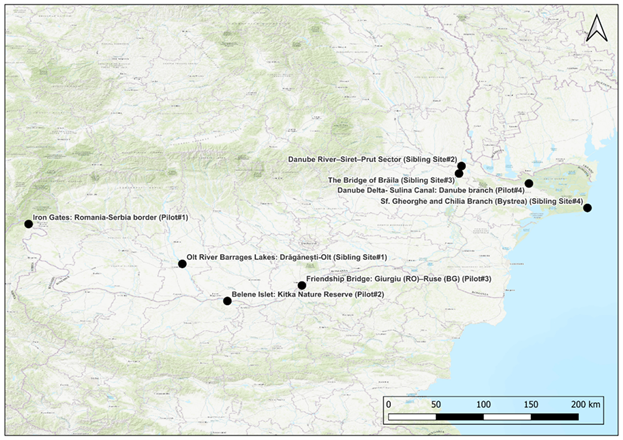
Emplacement: The Iron Gates, Belene Island, Friendship Bridge, Danube Delta.